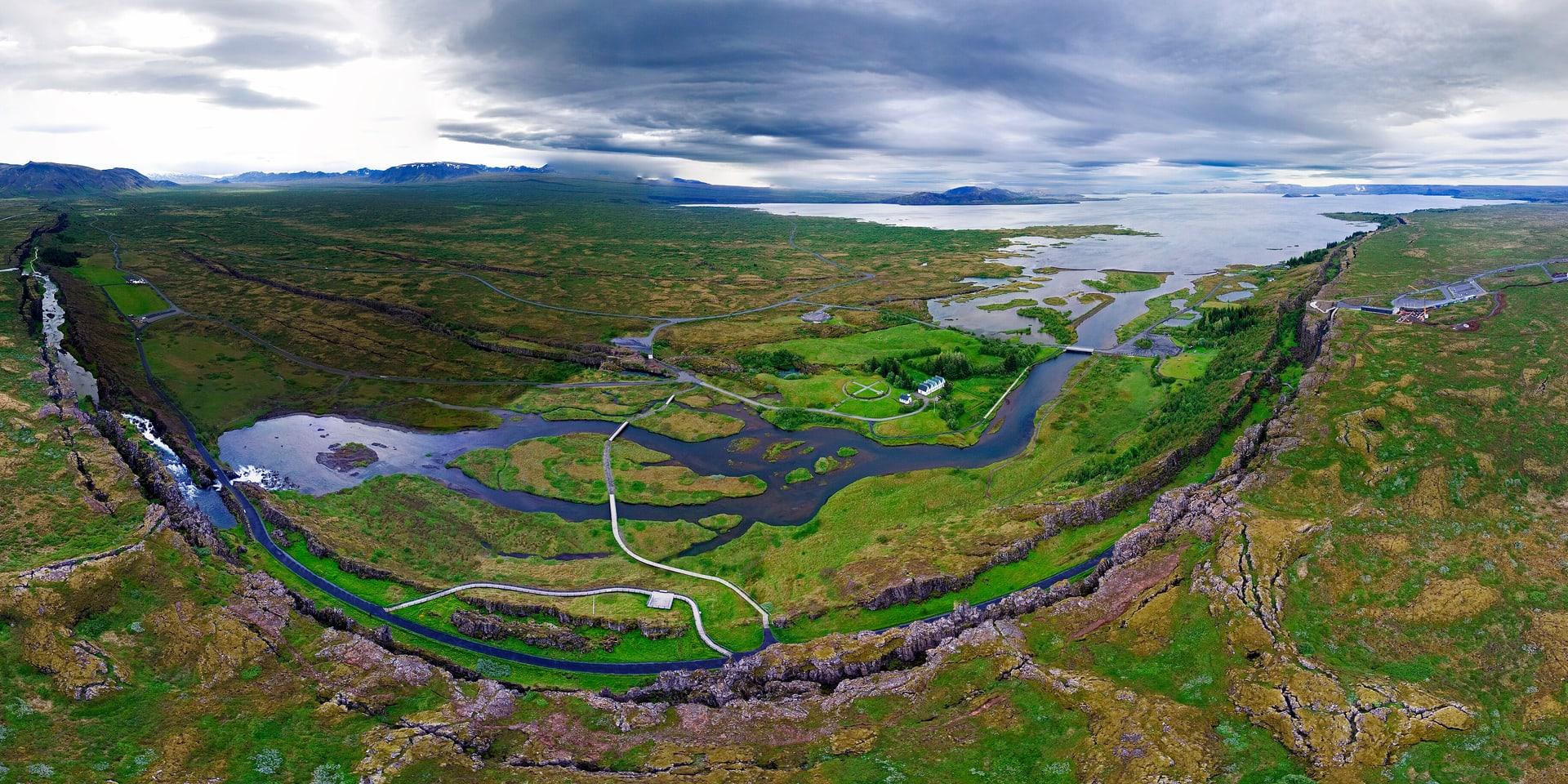
Þingvellir lies about 50 kilometres east of Reykjavík, and its name means the plains of the assembly. From about 930 until 1798 the Alþingi, the assembly of the whole country, met here in the open air for two weeks every summer, to make laws and settle disputes. The grassed-over ruins of its booths, the shelters of turf and stone that people lived in for the fortnight, still lie across the assembly ground. Þingvellir is one of the stops on the Golden Circle.
At the centre of the assembly was Lögberg, the Law Rock. The Law Speaker recited the laws there from memory, and anyone at the assembly could step forward and speak. In the summer of 1000 the assembly was split between heathens and Christians. The heathens' Law Speaker, Þorgeir Ljósvetningagoði, withdrew for a night and a day, then walked to Lögberg and declared that Icelanders should take the Christian faith, though heathens might go on worshipping in secret. Nobody knows exactly where Lögberg stood. The park names two places: the ledge at the top of the slope called Hallurinn, where the flagpole now stands, and a spot inside the gorge of Almannagjá, against its higher wall.
When Icelanders came under the king of Norway in the 1260s, Lögberg lost its purpose and the assembly became a court, which met at Þingvellir for the last time in the summer of 1798. In the nineteenth century the place became a symbol of the campaign for independence, and on 17 June 1944 the Republic of Iceland was founded here.
A law of 1928 made Þingvellir, from the beginning of 1930, a protected national shrine of all Icelanders and the country's first national park. It is one of three today, and the only one in the care of parliament: Þingvallanefnd, a committee of seven members of the Alþingi, runs it under an Act of 2004. UNESCO inscribed it on the World Heritage List the same year, as a cultural site; Iceland on UNESCO's lists sets it beside the country's other entries.
The valley is a rift. Three plates meet in Iceland: the North American, the Eurasian, and between them a small one, the Hreppar microplate. Þingvellir lies on the boundary of the North American plate and the Hreppar microplate, and the Eurasian plate begins further east. The boundary is a belt about 5 kilometres wide, from Almannagjá on the west side of the valley to Hrafnagjá across the lake, and the ground between sinks as the two sides draw apart. Since the lava of the valley floor flowed, some 10,000 years ago, the floor has sunk about 40 metres and the valley has widened about 70. Since the first assembly it has sunk almost 4 metres, enough to bring the lake up towards the assembly ground. The movement comes in bursts, and the last swept through the valley in the spring of 1789.
From Hakið, the viewing platform beside the park's visitor centre, a path goes down into Almannagjá, along the west side of the valley. The river Öxará was turned into the gorge, Sturlunga saga says, so that the assembly would have water close by. In the river is Drekkingarhylur, the drowning pool, where women condemned under Stóridómur, the Great Judgment of 1564, were drowned. Þingvallakirkja, the church on the assembly ground, was built in 1859.
Þingvallavatn, at the park's southern end, is the largest natural lake in Iceland, and at its deepest, 114 metres, it reaches below sea level. About nine tenths of its water arrives underground, through the lava and the fissures, some of it from Langjökull, the glacier to the north, 20 to 30 years on the way. Its Arctic charr have grown into four forms, each suited to its own habitat in the lake. Silfra, a fissure that carries the water in, is one of two places in the park where diving and snorkelling are allowed. The water is a few degrees above freezing, and the park's rules are on its diving page: never alone, never deeper than 18 metres, and at the diver's own risk.
The park's own site, thingvellir.is, carries its news; the roads are on the Road Administration's umferdin.is and the weather on the Met Office's vedur.is.
When the Alþingi's thousandth anniversary was kept at Þingvellir in 1930, Páll Ísólfsson's cantata for the festival was first performed there, under the composer, as Building the institutions tells. In the summers of 2024, 2025 and 2026 the park invited choirs to sing on Sundays, many of them by Lögberg in Almannagjá. In 2024, eighty years after the republic's founding, it asked them to sing the national anthem if they could: Lofsöngur, first sung in Dómkirkjan, the Cathedral of Reykjavík, in 1874. Its programme for August 2026 listed two evening concerts of old music in Þingvallakirkja, one with the langspil among its instruments. What comes next is on the park's events page, in Icelandic.