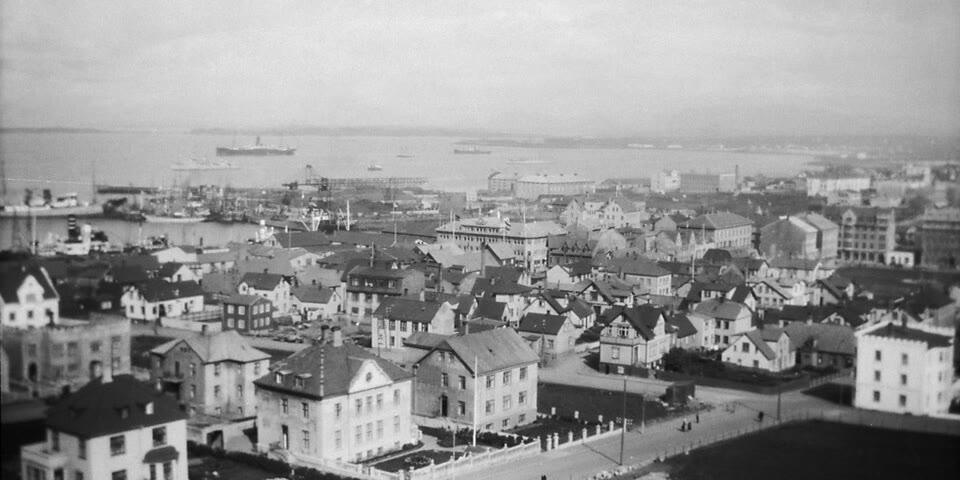
Icelanders first heard a symphony orchestra in concert in the summer of 1926, when the Hamburg Philharmonic came on tour under the composer Jón Leifs. Reykjavík already had an orchestra of its own, a few months old. Hljómsveit Reykjavíkur, the Reykjavík Orchestra, was founded on 11 October 1925 at a meeting of players and music lovers, and its chief movers were two composers, Sigfús Einarsson and Jón Laxdal. For its first years it was hardly more than a salon orchestra, made of whoever could play.
Many of its members saw early that this would never make a full orchestra, and the thousandth year of Alþingi, the parliament, bore them out. Páll Ísólfsson wrote a cantata for the festival at Þingvellir in 1930 and conducted it himself, and the Reykjavík Orchestra could not play it alone. Nine players from the royal orchestra in Copenhagen were hired to fill it out. What the players lacked was teaching, and the idea of a music school had already been raised that spring, for the first time, at the orchestra's annual meeting.
Tónlistarskólinn í Reykjavík, the Reykjavík College of Music, opened on 5 October 1930 with Páll at its head, and he stayed until 1957. Ríkisútvarpið, the state radio, began broadcasting on 20 December that year, and Páll ran its music from the start until 1959. Most of what it broadcast came off records, and the school supplied it with concerts through the winters, usually played by a trio of its teachers.
The orchestra ran the school for two winters and found the money too much for an association whose members came and went. On 27 June 1932 twelve men founded Tónlistarfélagið, a music society, which took over both, with everything the orchestra owned and owed: a few instruments, some sheet music and 71.40 krónur, against 2,000 krónur of debt. From 1934 the society staged operettas, which Páll hoped would lead in time to opera. It brought the Prague Quartet in June 1936, the first string quartet ever to come to Iceland. On 18 December 1939 it gave the first oratorio performed in Iceland, Haydn's Creation, rehearsed by Páll, in a large motor garage that its owner, Steindór Einarsson, had cleared for it. About two thousand people came.
Jón Leifs, who had conducted the Hamburg orchestra in 1926, lived abroad until the summer of 1945. Within days of his return he took part in founding Tónskáldafélag Íslands, the composers' society, which names him as its initiator and in 1980 founded the Dark Music Days festival. On 31 January 1948 the composers founded STEF, again at his initiative, to collect a fee when their music was performed, and he chaired it, with one break, until 1968. Icelanders met the idea with suspicion, and the force of his collecting made him a disputed man at home in his later years.
Reykjavík's own symphony orchestra gave its first concert on Thursday 9 March 1950, in Austurbæjarbíó, a cinema. The house was full and many were left outside. Páll spoke first, asking an audience that included members of Alþingi and the town council for the support that would let the orchestra last. He then conducted the national anthem, Ó, guð vors lands, and the audience stood. Róbert Abraham Ottósson, a German-born conductor who had settled in Iceland in 1935, conducted the rest: Beethoven's Egmont overture, seven Romanian folk dances by Bartók, a Haydn divertimento for five wind instruments, and Schubert's Unfinished Symphony.
The orchestra had forty-one members, and thirty-nine played. The state radio carried the cost at first. Twenty-four years after Icelanders first heard a symphony orchestra from Hamburg, they had one of their own. It is the Iceland Symphony Orchestra, and its home since the spring of 2011 has been Harpa, Reykjavík's concert hall.