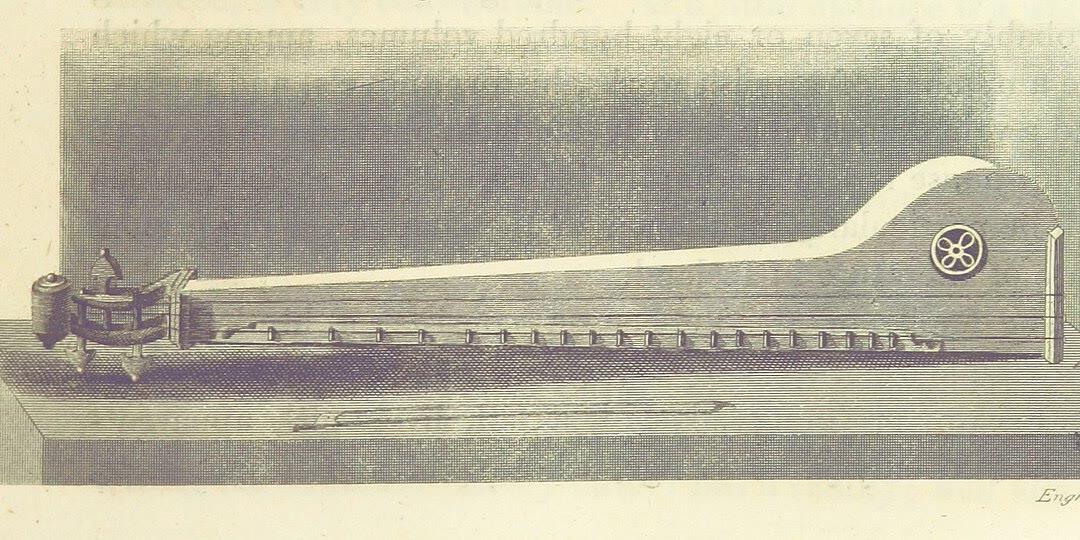
Two string instruments are best remembered from Iceland before 1900, and both were bowed. The langspil is a long, narrow wooden box, often wider at one end, with one to six strings and a fingerboard along one edge. It lay on a table or in the lap; the left thumb stopped the melody string, the right hand drew the bow, and the other strings droned beneath. The fiðla was shorter and wider, a hollow box with usually two strings, at first of horsehair, like its bow.
The sources disagree about their age. Folk tales tell of Fiðlu-Björn from Skagafjörður, said to have travelled about playing the fiðla at the end of the sixteenth century. Guðmundur Erlendsson, a priest who died in 1670, likened his book of verse to a fiðla with two strings: one half was rímur, the chanted narrative poems, and the other hymns. The oldest written sources on the langspil are from the eighteenth century, says the American music professor David G. Woods.
Travellers wrote both down. Uno von Troil, who came with Joseph Banks's expedition in 1772, saw a langspil with six brass strings and a fiðla with two of horsehair, both bowed. Banks took a four-stringed langspil home and gave it to the music historian Charles Burney. George Steuart Mackenzie was at dinner at Innri-Hólmur in 1810 when music came from the room above, and the party took it for a piano. It was two langspil, played by the son and daughter of the house. Close to, he wrote, the sound was rather harsh, and from the next room very pleasing. The tunes were mostly Danish and Norwegian.
Their father, Magnús Stephensen, was seen in his day as the embodiment of the Enlightenment in Iceland. In print he called the two best suited to songs of sorrow, and the fiðla, a coarse horsehair string over a hollow box, especially intolerable. Many parish priests thought the same. In 1839 they were sent questions about their parishes, and of the 144 published answers that say anything about instruments, 65 name the langspil and six the fiðla, many of them as if neither quite counted as one.
The langspil found new work in 1855, when Ari Sæmundsen published Leiðarvísir til að spila á langspil, a guide to building and playing one and to learning the hymn tunes from notes. Pétur Guðjohnsen, the cathedral organist, warned that a langspil had only one scale, and some readers used Ari's book to fret in the missing semitones. The fiðla went first. Helgi Sigurðsson wrote in 1891 that he had last seen one between 1820 and 1830, and by the time Bjarni Þorsteinsson began collecting folk songs about 1880 it had all but disappeared.
From late in the nineteenth century, in the spirit of romantic nationalism, the old instruments came to be prized as Icelandic. Bjarni held the langspil to be wholly native, and in 1919 Matthías Þórðarson, keeper of the National Museum, called the fiðla unique of its kind. Reading the sources from 1500 to 1900 for the journal Saga in 2016, Rósa Þorsteinsdóttir found that neither had been Iceland's alone. The langspil probably came from Norway, where its relative is the langeleik, and Woods counts the Appalachian dulcimer among its kin. Instruments like the fiðla were known elsewhere in the Nordic countries in the Middle Ages. The instruments themselves, though, were often made at home, and langspil, it is thought, were once made of driftwood.
The National Museum in Reykjavík keeps two fiðlur: one given in 1888 and thought to be the work of a farmer in Rangárvellir, and one built for Bjarni in 1905 from what men in Kelduhverfi remembered of the fiðlur of their youth. Woods measured twenty-one langspil in museums and homes in 1981, most of them pine, and one had been built in 1950 by a man of ninety in Dalvík. In the house in Siglufjörður where Bjarni lived, Þjóðlagasetrið, the Siglufjörður Folk Music Centre, shows Icelandic instruments from his household, and its films of people singing and playing include the langspil and the fiðla. The society behind the centre also organises the Folk Music Festival in early July.