The Reykjanes peninsula is the first ground a visitor sees. Keflavík International Airport stands on it, and the road from the airport to Reykjavík runs along its northern shore. The peninsula had been quiet for about eight centuries when the ground began to shake. The Catalogue of Icelandic Volcanoes, updated 1 September 2026, dates the last eruption on the Reykjanes system to the year 1240, at the close of what are called the Reykjanes Fires. The Fires ran from about 1210 to 1240; the Catalogue counts at least six separate eruptions in those decades, at intervals of two to twelve years, with activity moving west across the peninsula as the fires went on. The largest of them, in 1226, laid down a layer of tephra the Catalogue says reached the Reykjavík area, some forty-five kilometres east. It also says that volcano-tectonic periods on the peninsula come at intervals of nine hundred to twelve hundred years. The Natural Science Institute counts around forty-one volcanic systems in Iceland, including the submarine ones, and the Reykjanes system is partially submarine: the peninsula is the above-water edge of the Mid-Atlantic Ridge, where the North American and Eurasian plates are diverging.
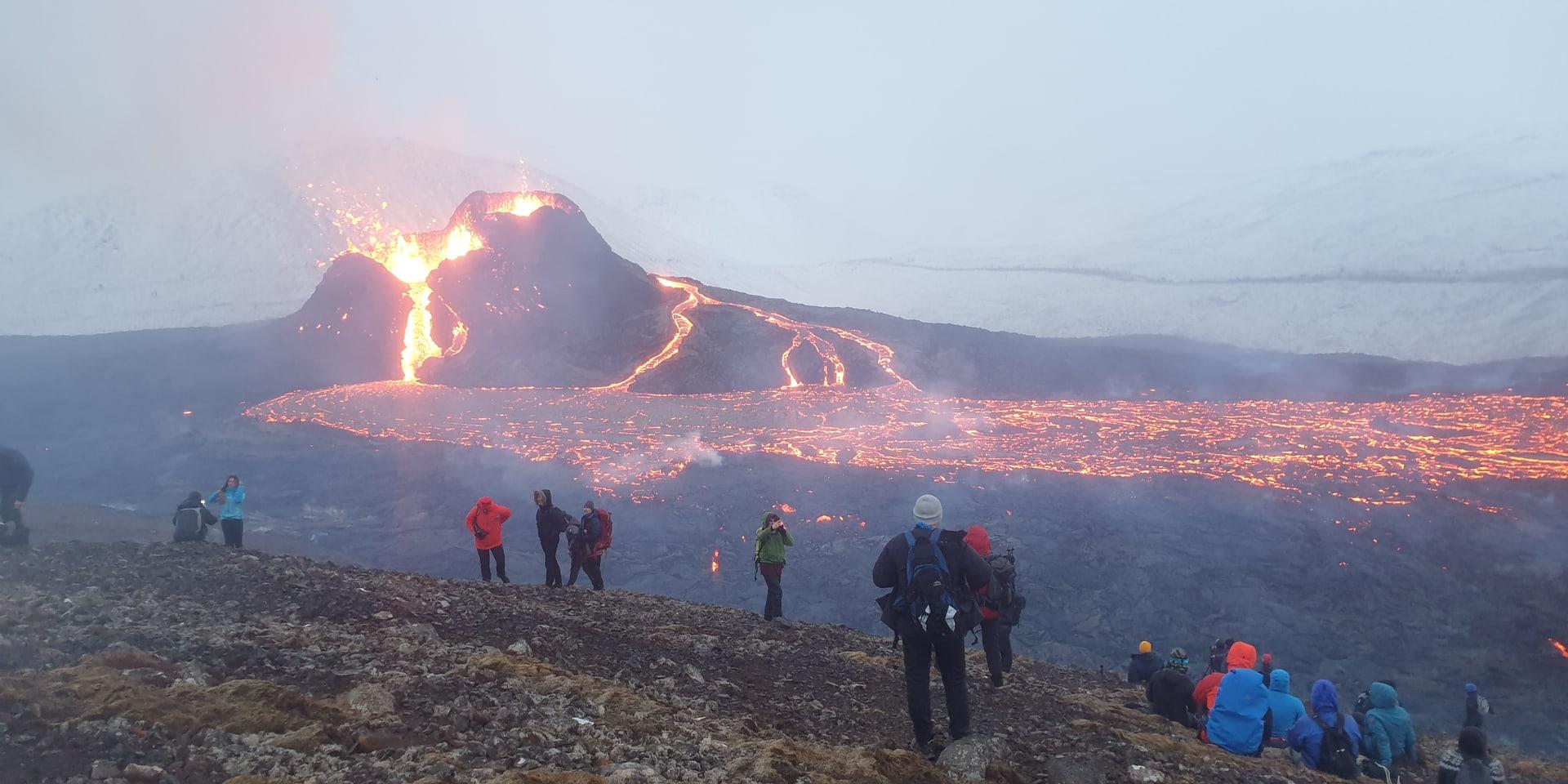
Fagradalsfjall erupted in March 2021, a small fissure in a valley some way inland from any town. It was the first eruption on the peninsula since the thirteenth century. The lava came in episodes through the summer and the autumn, and drew many thousands of walkers to the ridges above it. The mountain erupted again in August 2022, and in July 2023; each time the fissure opened in a different place, and each time the lava stayed in the valleys.
Then the activity moved. The Met Office noted on 10 August 2023 that activity on the peninsula had entered a new phase. The Catalogue lists Svartsengi as a volcanic system beside Reykjanes, and dates its last eruption, like Reykjanes's, to 1240; it counts about fifty square kilometres of lava erupted there between 1230 and 1240, more than three tenths of a cubic kilometre in all. In 2023 a new crater row opened on the Sundhnúkur fissure, further northwest, and closer to the town of Grindavík. "From 2023 to 2025," the Catalogue says, "nine lava forming eruptions occurred on the Sundhnúkur crater row."
In January 2024 a fissure opened within Grindavík. The town was evacuated, and has been evacuated several times since. The Blue Lagoon, which sits on the edge of the Svartsengi geothermal field, has closed on short notice as well. Cracks in the streets of Grindavík and subsidence of the ground have followed. Much of the peninsula sits inside the Reykjanes Geopark, which covers the coast, the lava fields and the geothermal areas of the whole southwest tip, and is on UNESCO's tentative list for recognition as a global geopark.
The ninth Sundhnúkur eruption, according to the Icelandic Met Office, ran from 16 July to 5 August 2025. Uplift at Svartsengi then resumed. On 9 June 2026 the office reported that about 27.5 million cubic metres of magma had accumulated beneath the ground since mid-July 2025, and that the uplift was continuing at a steady rate. On 9 November 2026 it reported that the slow uplift was continuing and that a new intrusion was the most likely scenario. The office has given no date for what may come next.
Whether an eruption is under way today, whether a road is closed, whether the Blue Lagoon is open and whether Grindavík is open to visitors change by the week. The Met Office keeps its volcanic news page current. Safetravel carries the conditions on the peninsula and the warning that walking on fresh lava is forbidden, and the Road Administration carries the state of the roads.
Music on the peninsula is in Reykjanesbær, the town built where Keflavík and Njarðvík meet, half an hour's drive from Keflavík International Airport. Hljómahöll is a complex that holds the Stapi and Berg concert halls, the Reykjanesbær music school and Rokksafn Íslands, the national rock and roll museum. Keflavíkurkirkja, the church above the harbour, holds the Orgóber organ series each October, and Sandgerðiskirkja, a short way north on the coast, is on the touring circuit that brought the Sound of Iceland autumn season here in 2026. None of the venues lies in the eruption zone, and the concerts have gone on.