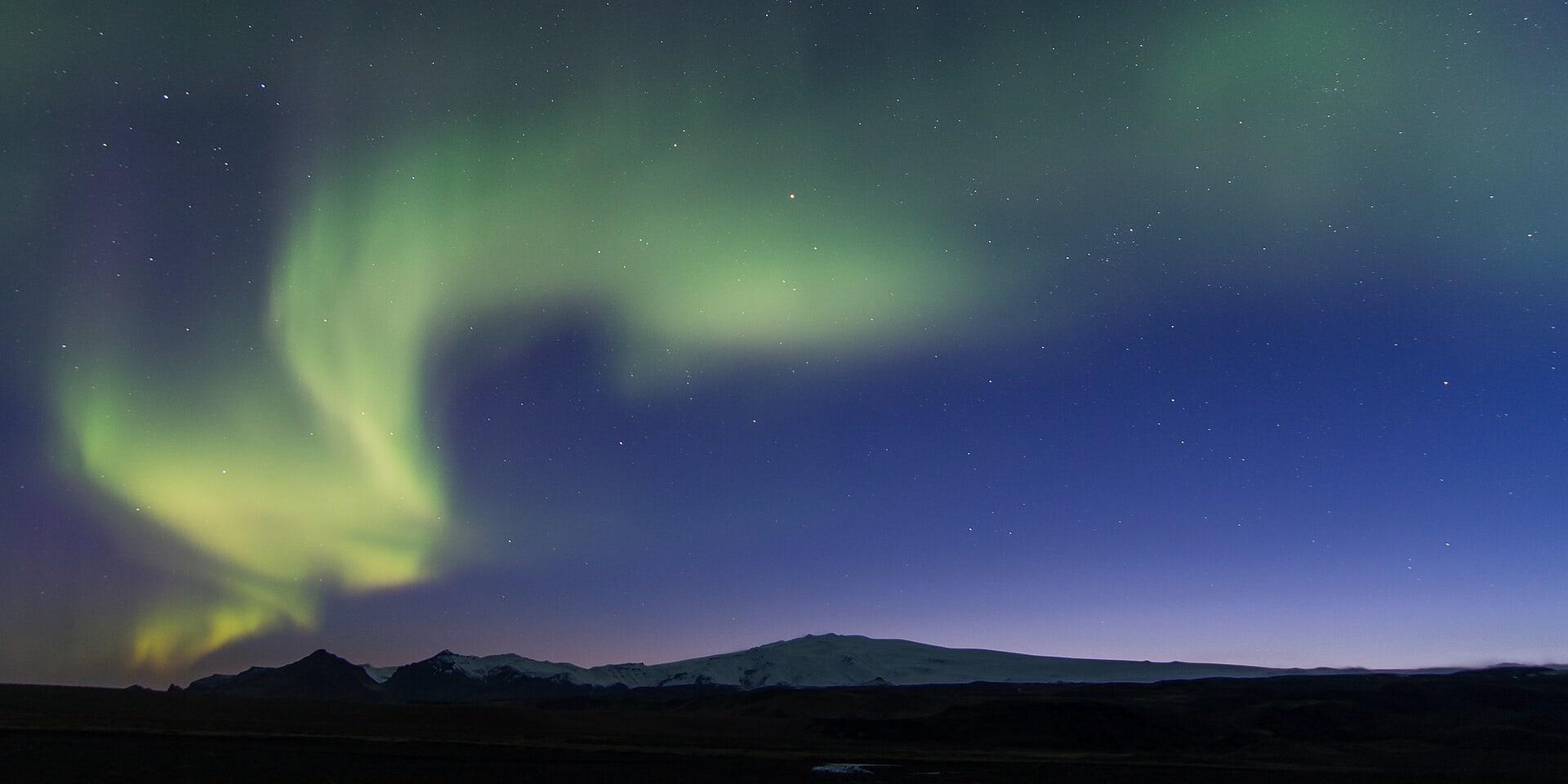
The sun sends out a steady stream of charged particles, mostly protons and electrons, called the solar wind. The earth's magnetic field turns most of them aside. Near the magnetic poles some get through, and where they strike the upper atmosphere they excite its oxygen and nitrogen, which give the energy back as light. Vísindavefur, the University of Iceland's science web, puts that light most often between 100 and 250 kilometres up. The colours seen most are green, from oxygen, and a reddish violet, from nitrogen.
The particles get in mostly along a ring round each magnetic pole, the auroral oval, and on an ordinary night Iceland lies under the northern one. By day, the Icelandic Met Office explains, the oval lies just north of the country and moves over it in the evening; when the display is strong it widens and reaches further south. So the lights over Iceland can stand in almost any part of the sky, often high and at times straight overhead.
They are there in summer as well, but an Icelandic summer night is too light to show them. Visit Iceland, the country's official travel guide, gives the season for seeing them as September to April. Safetravel, run by the Icelandic Association for Search and Rescue, says it usually lasts from late August to late April. A Norwegian book written between 1250 and 1260, Konungs skuggsjá, says of the lights over Greenland that they grow brighter as the night grows darker, show at night and never by day, and come most often in deep darkness and seldom by moonlight.
The Met Office publishes an aurora forecast for the days ahead. Its map of Iceland shows the forecast cloud, green where it will be cloudy and white where the sky will be clear, with tabs for low, middle and high cloud and for all three together. A box at the top right gives the expected activity at midnight on a scale from 0 to 9, and the same panel gives the times of sunset, darkness, sunrise and moonrise, which are Reykjavík's. Move the slider beneath the map, or choose a day and an hour, and the box follows.
The scale is the Kp index, which measures how strongly the earth's magnetic field is varying. Most of the time, the Met Office says, it stands between 0 and 3, and the highest figures are very rare; its help page calls 2 low and 3 moderate, and says either can make a fine display. Because the solar wind takes one to three days to cross from the sun, a large magnetic storm can usually be seen coming. Visit Iceland says there are no guarantees, and that the more nights a visitor has, the better the chance.
The lights can be seen from Reykjavík itself on a clear, active night, the same guide says, though a faint display shows better away from the town. On Vísindavefur the astronomy teacher Sævar Helgi Bragason, in an answer last revised in 2020, names dark places within reach of the capital, among them Kleifarvatn and Krýsuvík near Hafnarfjörður, and Þingvellir, where the lights of the summer houses take something from the dark. No one place is better than another, he writes: what counts is the oval overhead, a clear sky and the dark.
Safetravel's page on watching for the lights speaks first to drivers. It asks them to park only in a designated car park, never to stop on the road or anywhere unsafe beside it, and not to step into the road for a picture: the roads are narrow, and in the dark another driver can hardly see a car or a person. Its page on winter driving and the Road Administration's road conditions say how the roads are on the night.
Konungs skuggsjá is also where the word Icelandic still uses is first written down: norðurljós, northern lights. It answers a question about the thing "that the Greenlanders call norðurljós". The sagas never mention the lights directly, writes Aðalheiður Guðmundsdóttir, a professor of early Icelandic literature. Folk belief made little of them either: the folklorist Símon Jón Jóhannsson records that lights which moved a great deal and changed colour foretold a gale, still ones a calm, and red ones war.
Harpa, the concert house in the middle of Reykjavík, has a hall that bears the word: Norðurljós. At the end of January, well inside either season, Dark Music Days holds most of its concerts in Harpa, and in 2026 seven of them were in Norðurljós.