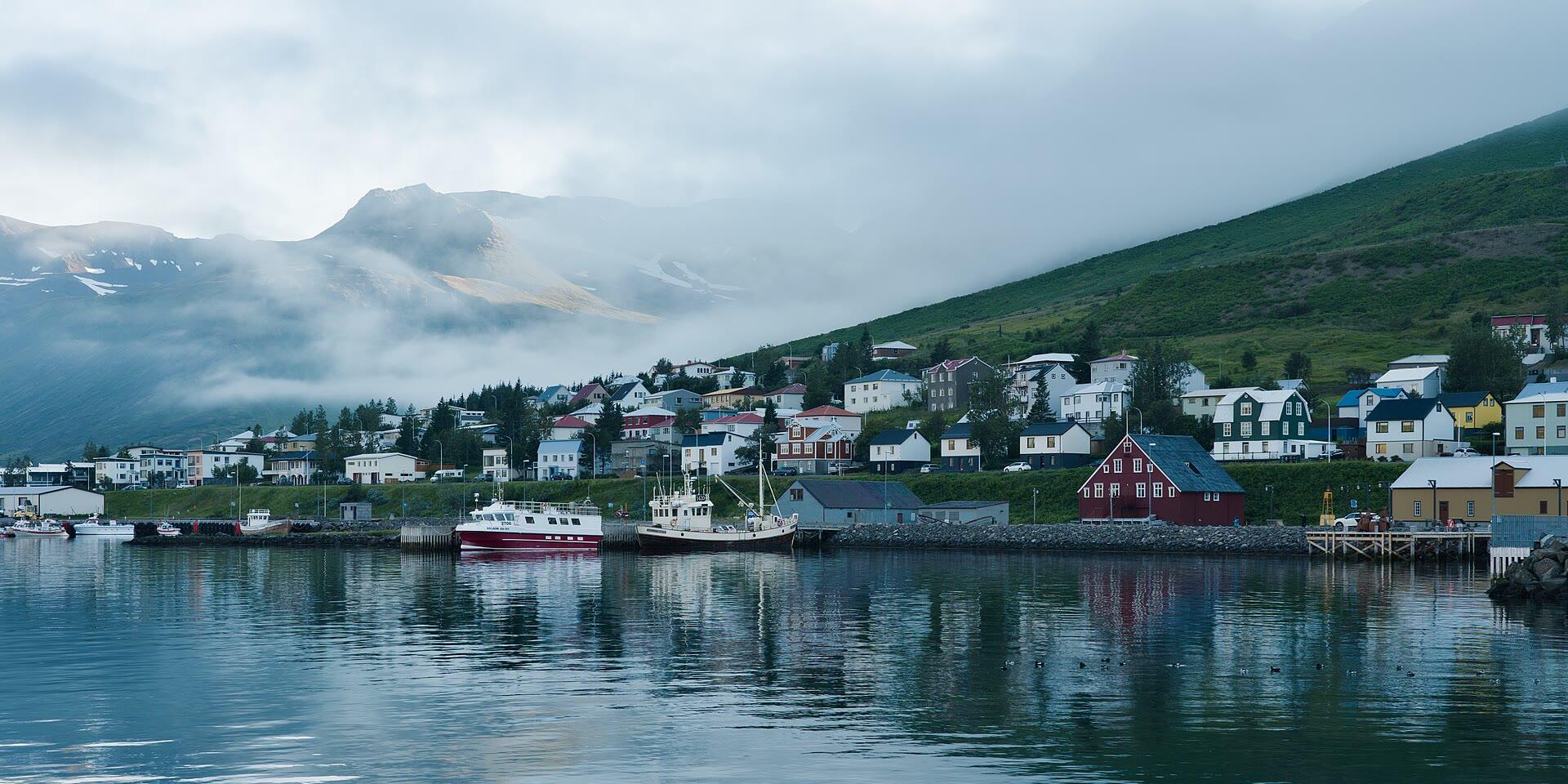
Bjarni Þorsteinsson was born in 1861 and came to Siglufjörður newly ordained in 1888. He was parish priest of Hvanneyri there until 1935, close to half a century, and a composer known across the country. He died in 1938. Before he was twenty, around 1880, he had begun writing down folk songs, and he went on collecting them for twenty-five years.
The tunes came from many places. Some were in old manuscripts, and he went abroad twice to read them, to Copenhagen and to Stockholm. Some came out of printed books. Many he took down himself from the people who sang them, especially in the north, and sixteen others sent him tunes they had written down in other parts of the country. The collection names 175 people as its sources. The songs taken from memory matter most, since no written copy of them existed and without him they might well have been lost.
Some of the old music was slipping away when Bjarni began. The fiðla, a two-stringed Icelandic fiddle made from a hollow box, had all but disappeared by 1880, and he had one made. It is kept in the National Museum of Iceland.
The Carlsberg Foundation in Copenhagen paid for the printing, and the book appeared there between 1906 and 1909 as Íslenzk þjóðlög, Icelandic folk songs, some 950 pages long. It remains the largest collection of Icelandic folk song. Inside are single-line melodies and tvísöngur (the old Icelandic two-part singing), the tunes of the Passion Hymns and more than two hundred rímur tunes, with an essay of his own on how rímur were chanted.
Rímur are long narrative poems, chanted at evening gatherings in farmhouses and fishing huts, and each canto, or ríma, usually went to one tune from start to finish. Hallgrímur Pétursson's Passion Hymns were sung or read on farms across the country through Lent, and when Bjarni was collecting, theirs were the old hymn tunes most people still remembered.
For his first ten years in Siglufjörður Bjarni lived in Maðdömuhús, the Madame House, one of the oldest houses in the town. Þjóðlagasetrið, the Siglufjörður Folk Music Centre, opened there on 8 July 2006, a hundred years after the book began to appear. Its rooms show films of people of all ages from all over the country chanting rímur and nursery rhymes, singing tvísöngur, hymns and druslur (comic verses sung to hymn tunes), and playing the langspil and the fiðla. Gunnsteinn Ólafsson began making the films in 2005 with the film-maker Dúi Landmark, and hundreds of the tunes were taken from the last generation to have learned rímur and folk songs from their elders. On show beside them are things from Bjarni's household, among them his manuscripts of folk songs and of his own compositions, and Icelandic instruments.
The Siglufjörður Folk Music Festival was first held in the summer of 2000, six years before the centre opened. The society behind the centre organises it, and it is held in early July. One of its stated aims is to keep the collector's name alive.