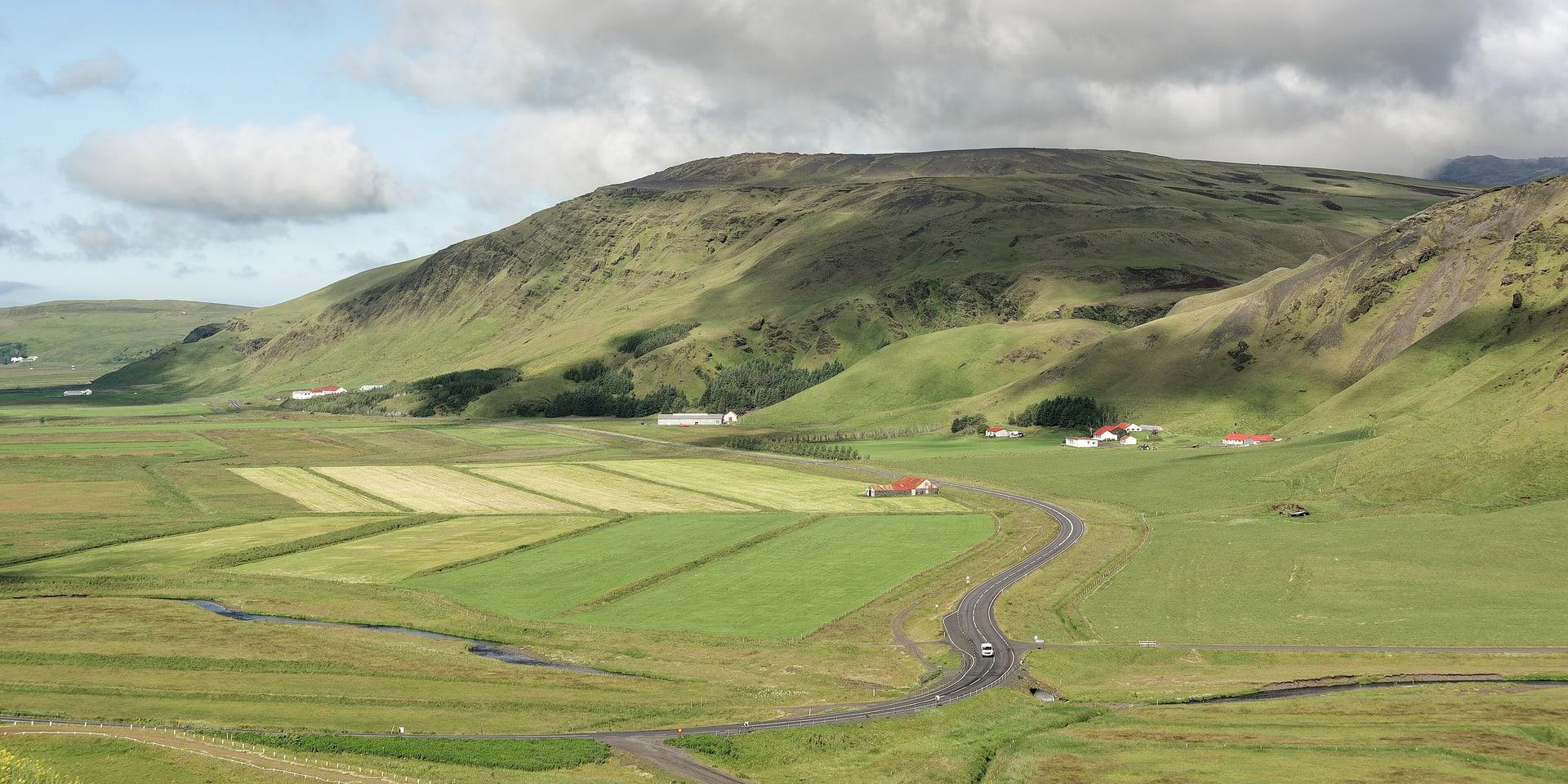
The South Coast is the name the tourist offices give to the country that Route 1, the Ring Road, crosses on its way east from Reykjavík, and where it ends depends on who is counting. Visit Iceland, the country's official travel guide, ends the trip at Höfn. Visit South Iceland, which markets the region, draws its map of the route on past Höfn to the mountain Vestrahorn. Every town on the way from Hveragerði to Höfn lies in the region this site's listings call the South, which Statistics Iceland widened on 1 December 2020 to take in Hornafjörður, the municipality that holds Höfn and Jökulsárlón.
Out of Reykjavík the road goes over the heath of Hellisheiði, passes Hveragerði and crosses the Ölfusá at Selfoss. It goes on across Flói to the Þjórsá, and through Hella and Hvolsvöllur to the Markarfljót.
Beyond that river the places a visitor comes for lie close to the road, and each has a piece of its own. Seljalandsfoss and Skógafoss are a short way off it, the first at Seljaland, where road 249 turns off, the second at Skógar, down a short side road. On Sólheimasandur the road crosses the Jökulsá on a bridge opened in October 2022, the third over the river, and on its far side road 221 leads up to Sólheimajökull. Reynisfjara and Dyrhólaey come next: road 218 runs down to the headland of Dyrhólaey, and road 215 to the beach at Reynisfjara. Then the road enters Vík, about 190 km from Reykjavík by Visit Iceland's count.
East of Vík the road crosses Mýrdalssandur and the river Kúðafljót, then Eldhraun, one of the two tongues of lava that the eruption at Lakagígar in 1783 and 1784 sent down into the settled country. Kirkjubæjarklaustur lies just off the road, where road 205 turns in at the bridge over the Skaftá. Further east, through Síða and Fljótshverfi, new two-lane bridges took the road over Hverfisfljót in November 2022 and over Núpsvötn in June 2023.
Then comes Skeiðarársandur, the last gap in the ring. The Road Administration dates the Ring Road from 1974, when bridges over Skeiðarársandur joined its northern and southern parts. Sveinn Sveinsson, the Road Administration's former regional manager in the east, who retired after more than forty years with it, recalled in its newsletter in 2026 how a jökulhlaup, a flood from under the glacier, cut the road here in long stretches in November 1996, took the bridge over the Gígja and badly damaged the one over the Skeiðará, and how a temporary road and bridges were built in ten days.
Beyond the sand, road 998 leads in to Skaftafell and Svartifoss, in Vatnajökull National Park. The road goes on through Öræfi and across Breiðamerkursandur, where it crosses the other Jökulsá beside Jökulsárlón, about 380 km from Reykjavík by Visit Iceland's count. Past Suðursveit and Mýrar it reaches Hornafjörður, where almost 19 km of new road and four new bridges opened on 24 June 2026 and shortened the Ring Road by 12 km. Höfn lies off it, on road 99, which leaves the Ring Road at a roundabout built with the new stretch. The Ring Road goes on east.
When the bridge on Sólheimasandur opened in 2022, the government said that no single-lane bridge was left on the Ring Road from Reykjavík to beyond Kirkjubæjarklaustur. East of there, the bridges over Hverfisfljót and Núpsvötn and the new road in Hornafjörður have since taken five single-lane bridges off it. The Road Administration still counted 26 on the whole Ring Road in July 2026, and Safetravel asks drivers to slow down in good time before one.
Safetravel also asks drivers never to stop on the road, or at its edge, for the view, but to find a safe place off it. In winter it warns that wind, snow, rain and drifting snow can make a road difficult and sometimes dangerous while it still looks clear, that winter conditions can come in spring and autumn too, and that daylight is short. The Road Administration adds that on stretches a long way from any town, help can be far away, and asks travellers to carry what they would need in an emergency. On the day, its umferdin.is shows the state of each stretch, the Met Office's vedur.is the wind and the weather, and safetravel.is any warning in force.
The music on this road comes near its start. A couple of hundred metres from the town end of the Ölfusá bridge in Selfoss, by the river on Kirkjuvegur, stands the Church of Selfoss, consecrated on Palm Sunday 1956. Its first parish priest, Sigurður Pálsson, had a keen interest in reviving the old chant and order of the mass that Icelanders associate with the Graduale of 1594, the book The Lutheran centuries describes.