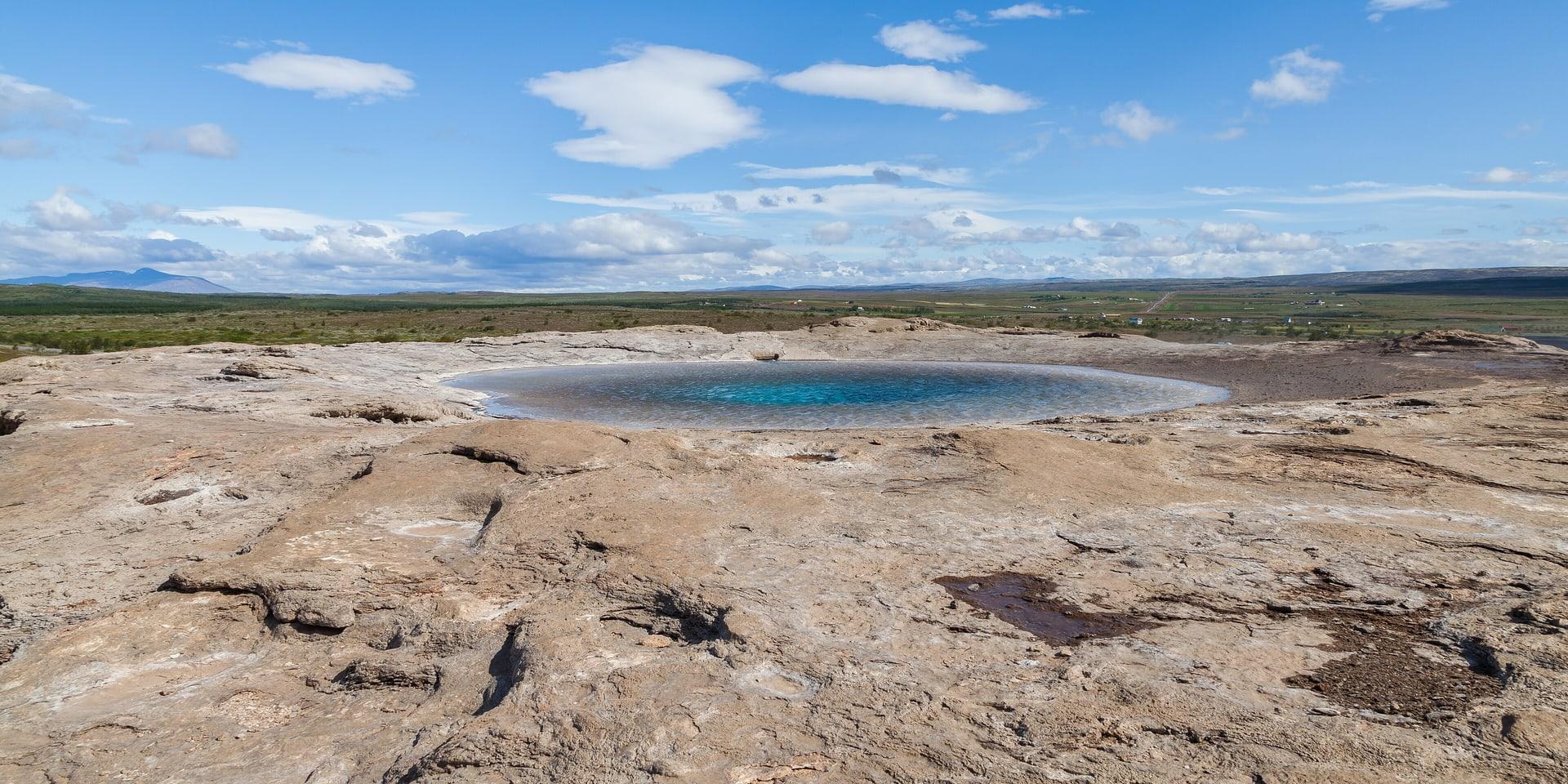
In Haukadalur, under the hill of Laugarfell, lies a field of hot springs that has been written about since the thirteenth century. Its most famous springs are Geysir, which has been dormant for years, and Strokkur, which erupts at short intervals. The springs and the hill, 1.2 square kilometres in all, have been a natural monument since 17 June 2020, in the care of the Nature Conservation Agency. The field is a stop on the Golden Circle, beside Road 35, and Gullfoss is further up the same road.
In most other languages a geyser is named after this one. The oldest example of the English word in the Oxford English Dictionary, from 1763, comes from an English account of Geysir, Professor Guðrún Kvaran writes on the University of Iceland's Vísindavefur. In their Travels in Iceland, Eggert Ólafsson and Bjarni Pálsson, who came to see it in 1750, wrote that the name meant one who rushes off in rage or frenzy. The geysers of Haukadalur are first named in the annals after great earthquakes in the south in 1294, and Geysir itself may have formed in them, though the field is thousands of years old.
Earthquakes have woken it more than once. Geysir was most active after them, as in 1630, and in its quiet spells people threw stones and turf into the springs to make them erupt. In the earthquakes of 1896 it came back, erupting several times a day; by about 1915 it was quiet again. In 1935 a channel was cut into the rim of its bowl to lower the water, and it began again. Sinter, the crust of silica the water leaves, slowly filled the cut; in 1981 it was dug out deeper, and Geysir was then often made to erupt with soap. After the South Iceland earthquakes of 2000 it came to life for a time before falling dormant, and the agency gives 2016 as the last year it is known to have erupted.
The chemist Robert Bunsen examined Geysir in 1846, and his explanation has largely stood. The water deep in its narrow pipe is held below boiling by the weight above it until some of it flashes to steam, and then the whole column boils and goes up at once. At its best, Geysir threw water 60 to 80 metres into the air.
Strokkur works differently. Its pipe does not empty between eruptions, so it fills again quickly, and it goes up at short intervals in small, hard bursts as high as 30 metres; in 2017 a few minutes usually passed between them. Just before an eruption a large bubble swells at the surface, and the jet sometimes breaks up through it. Strokkur has slept too. Its greatest eruptions in the nineteenth century are said to have lasted an hour and reached 60 metres, and it had been dormant for decades when a hole about 40 metres deep was bored into its bowl in 1963. It has been very active since.
A metre below the surface, Strokkur's water is 90 to 95°C, the geologist Helgi Torfason writes, and at the bottom of its pipe about 130°C. The protection notice requires everyone to keep to the marked paths in the hot spring area, for safety and to spare the sinter, and forbids bathing in the springs and throwing anything into them, stones and soap among them. The field also changes. In October 2024 the rangers found Blesi, Konungshver, Fata, Smiður, Óþerrishola and other springs, usually quiet, boiling hard or erupting in small bursts all at once, and asked visitors to take extra care. The agency keeps a page on the area, and Safetravel the day's warnings.
Within the monument are the Konungssteinar, the kings' stones, which mark the visits of three Danish kings to Iceland: Christian IX in 1874, Frederick VIII in 1907 and Christian X in 1921.
Jón Leifs, who now and then set out to describe the Icelandic landscape in music, wrote an orchestral prelude called Geysir, Op. 51, in 1961. In the notes to its recording by the Iceland Symphony Orchestra under Osmo Vänskä, Hjálmar H. Ragnarsson hears the din of the great geyser throwing boiling water at the sky, and a man standing small and helpless before the power of the earth. Some of its percussion is found only in his works, says Iceland Music, which publishes the score. It was first performed in November 1984, sixteen years after the composer died.