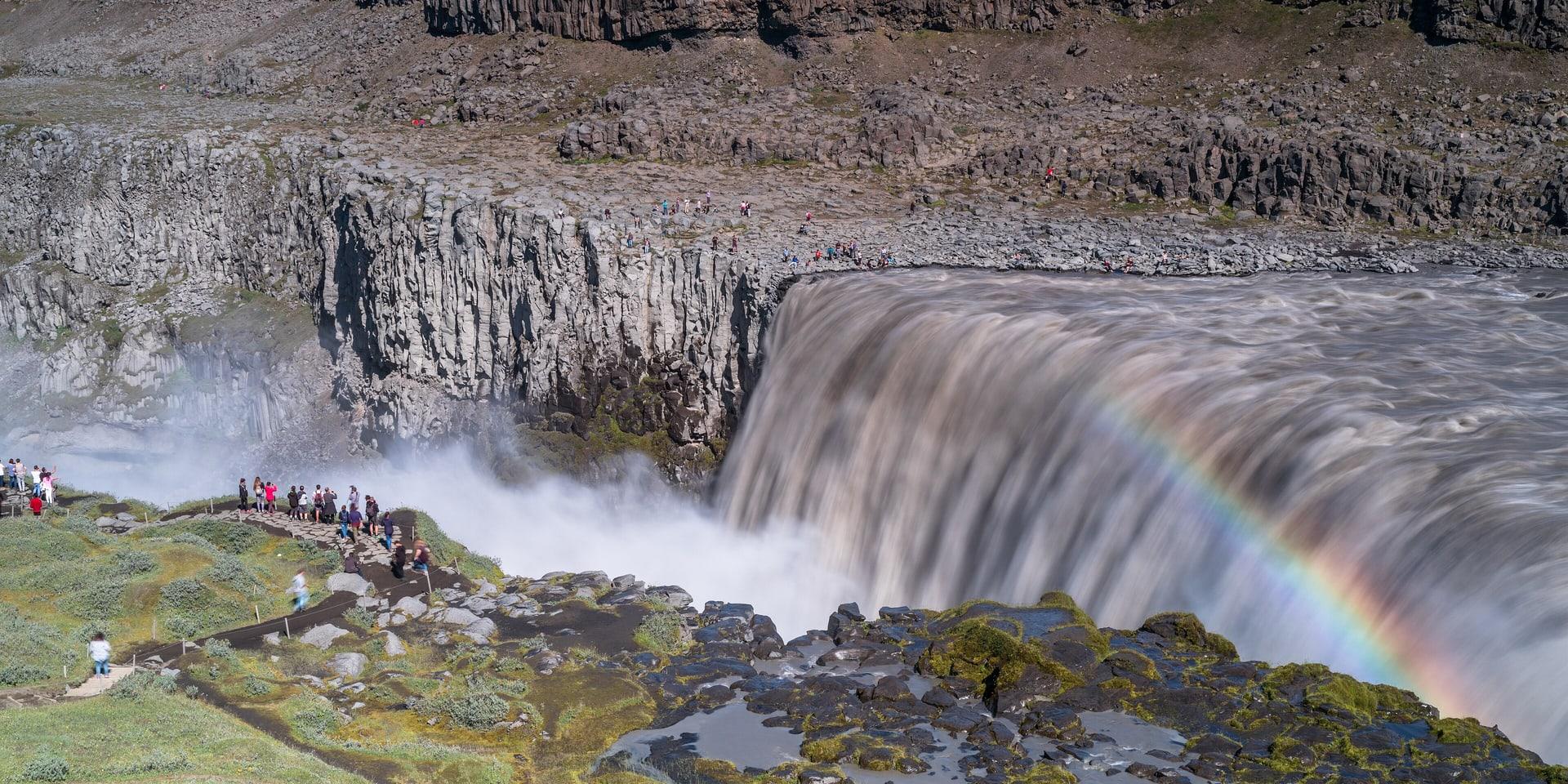
The volcanic country around Lake Mývatn, the ridge at Krafla and the waterfall at Dettifoss, in the Jökulsárgljúfur canyon, have carried a number of film crews since the early 2000s. Treeless ground and dark lava, the solfatara field at Hverir, the hot cave of Grjótagjá and the ice country north of Vatnajökull have each been used for places well away from Iceland on screen. The place itself is described in Krafla and Mývatn; this piece follows what has been filmed there.
Game of Thrones shot in the Mývatn area across seasons two, three and four, using the country north and east of the lake for the land beyond the Wall. The Reykjavík Grapevine's 2014 report names Grjótagjá, the hot cave east of the water, as the setting for the scene between Ygritte and Jon Snow, and says the Lake Mývatn area carried the Wildling camps. The same report calls the tuff cone of Hverfell "easy to spot in season three" and says the bubbling mud at Hverir supplied the steam the production used to render a blizzard. The article's other Mývatn-area names (Goðafoss "purportedly", Dimmuborgir as a place a tour visits) are not stated as filming claims and are not carried here.
The crew of Star Wars: The Force Awakens came to the same country in 2014. Iceland Review reported in April 2015 that the shoot had taken place in the Mývatn area and around Krafla the summer before, citing Vísir, and that the crew were expected to return to Iceland for further scenes. The paper did not name the sequence.
The Fate of the Furious (2017) brought its ice-chase sequence to Iceland in 2016, Mývatn among the places named by Film in Iceland, with Akranes on the west coast announced alongside it. The 2024 film Kraven the Hunter is listed in the same catalogue as a Mývatn shoot. The connection between these two productions and the north is the look of cold country rather than any story set there.
Oblivion (2013) used Iceland for the scoured surface of Earth after a collapse. The production's northern location was Hrossaborg, a round tuff crater on the Jökulsá á Fjöllum route east of Mývatn, where the Grapevine's report of 15 June 2012 and Iceland Review on 28 June 2012 placed the crew. The film then carried on into the Highland: shots were taken at Þórisvatn, the long lake behind the Hrauneyjar power stations, and at Veiðivötn, the crater-lake field south of it. The piece names the Highland sites because the production used them in the same work, though a visitor to Mývatn would not reach them on the same trip.
Prometheus (2012) opens on a vast waterfall, and that waterfall is Dettifoss, in the eastern part of Vatnajökull National Park, where the Jökulsá á Fjöllum drops from the plateau into the canyon of Jökulsárgljúfur. Film in Iceland records the shoot at Dettifoss and places other scenes of the film below Hekla, in the south. The two places sit at opposite corners of the country, which is a pattern that recurs for a production using Iceland for an off-world plateau.
What draws productions this far north is partly the look of the country and partly the reimbursement scheme. The state reimburses part of what a production spends in the country; the scheme has run since 1999 and its rates have changed several times, with a separate tier for large productions in force since 2022. Film in Iceland carries the current rate. The rate itself is a figure that changes and is not printed here.
Mývatn, Krafla and the lake's music are described in Krafla and Mývatn. The road to Dettifoss through Jökulsárgljúfur leaves Route 1 at Reykjahlíð or east of the park; the Road Administration carries the state of the roads, the Met Office the weather, and Safetravel the alerts.