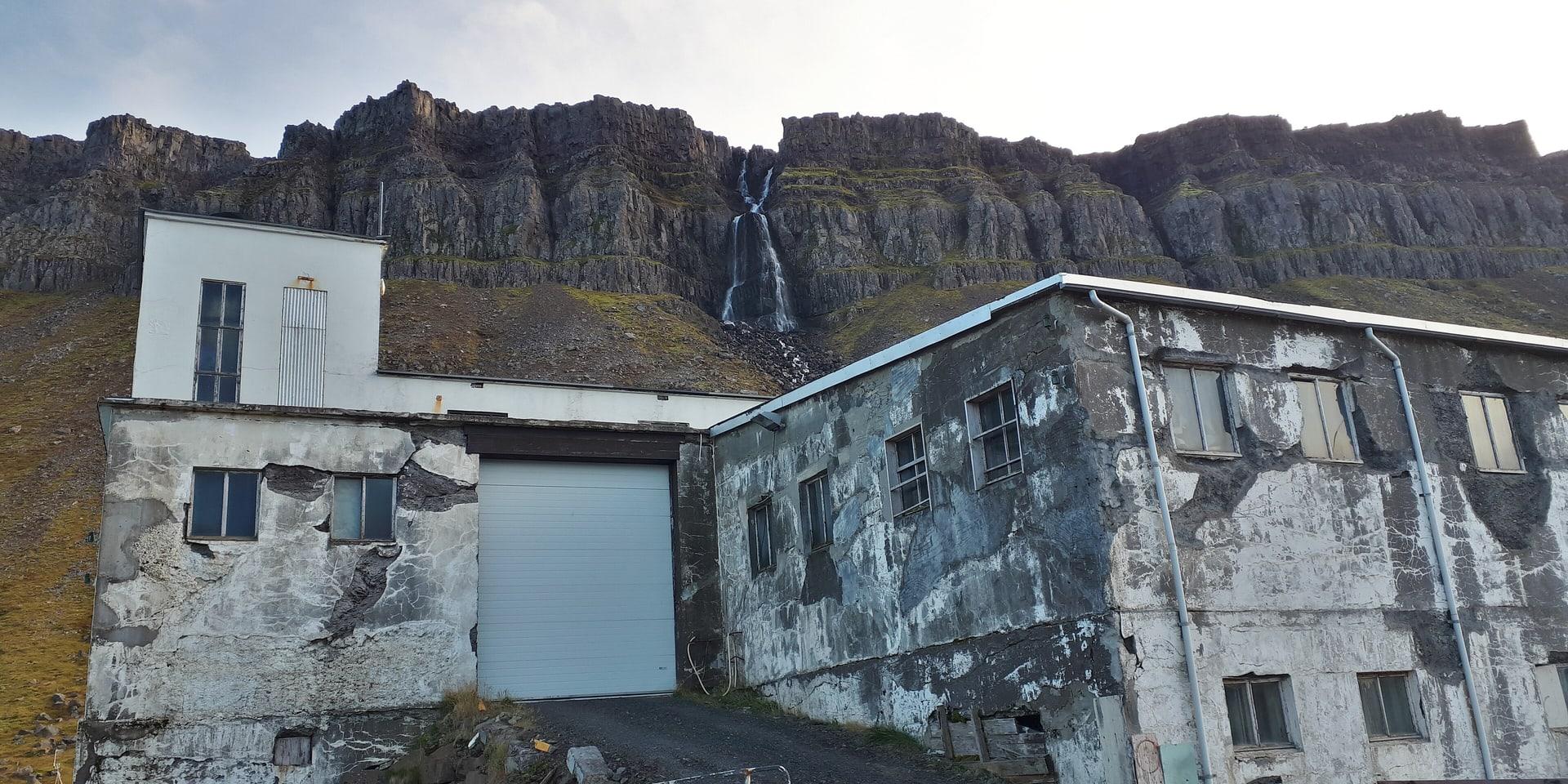
Djúpavík sits at the head of Reykjarfjörður on the Strandir coast of the eastern Westfjords, a cluster of a few houses, a hotel and the shell of an old herring factory. Its winter population runs to a handful: the most recent published figure records two or three residents through the cold months and a few more in summer. For much of the year the fjord, the mountains behind it and the sea are the place's company.
The factory began in 1934, when Djúpavík Ltd. was founded at Hótel Borg in Reykjavík and funded by a loan from a Stockholm bank. It was built in about a year, and when the production line started in 1935 it was the largest concrete building in Iceland, ninety metres long on three storeys. The last big herring catches came to the shore in 1944, and the factory closed in 1954. Its empty hall, concrete oil tanks and rusted pipes still dominate the inlet, kept as a museum. Halldór Laxness set his novel Guðsgjafaþula in the area, and the hotel's own history page names it among the factory's traces.
In 1985, Eva Sigurbjörnsdóttir and Ásbjörn Þorgilsson moved to Djúpavík with their three children and reopened the old barracks that had housed the women of the factory as Hótel Djúpavík. The first guests arrived that summer. The building was renovated to carry eight rooms on its upper floor, and the family has run the hotel since, mostly in the summer. Walks through the factory are offered to guests, and the building holds exhibitions of photography and art most years.
Sigur Rós toured the country in the summer of 2006 and played at fifteen stops, all of them free. The tour yielded the film Heima, released in 2007 and directed by Dean DeBlois. Among its locations was Djúpavík, where the band recorded the piece "Gítardjamm" inside one of the factory's circular fish-oil tanks. The tanks are concrete cylinders set into the hillside above the main hall; their inside carries a long, slow reverberation. The Djúpavík concert was one of the tour's smaller word-of-mouth stops, with the audience sitting on the floor. On film the footage reads close and quiet, very different from the open-air shows.
Djúpavík was taken over for a fortnight in October 2016 for the shoot of Justice League, directed by Zack Snyder. At the peak about three hundred crew and nearly two hundred motorhomes were on site, and five private jets used the Gjögur airstrip up the coast during the busiest days. Scenes with Ben Affleck, Jason Momoa, Amber Heard and Willem Dafoe were filmed at the factory, which was redressed for the opening sequence in which Bruce Wayne looks down on a fishing village in search of Aquaman. Djúpavíkurfoss, the waterfall above the inlet, carried the shot from which he looks. Scenes of Fjallsjökull, an outlet glacier at the southern edge of Vatnajökull National Park far from Djúpavík itself, were cut in beside them.
Getting to Djúpavík is a long drive. The road from the Ring Road winds through Hólmavík before turning north on Route 61, and at Bjarnarfjörður Route 643 Strandavegur branches off and climbs over passes and above the fjords for about sixty kilometres of gravel before reaching the village. Winter maintenance drops off in the north of the route, so Djúpavík can be cut off for months at a time. The Road Administration carries the state of the roads and Safetravel the warnings of the day.
A short way further up the coast at Krossnes a heated pool stands by the sea, filled from a spring on the shore, and the hotel points visitors to it.
For readers whose Iceland is films first, the place is unusual among filming locations. The factory is a disused building where what was heard, in Sigur Rós's hands, is as much part of the record as what was seen; Justice League was a visit that passed through.